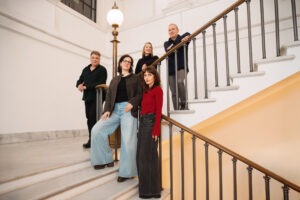
Vom 4. bis 19. Oktober 2008 besuchen 16 Fellows auf Einladung der Frankfurter Buchmesse die Verlagsbranche in Frankfurt, München und Berlin – seit Dienstag dieser Woche sind sie auf der Frankfurter Buchmesse unterwegs. buchmarkt.de stellt Ihnen täglich einen der Teilnehmer vor.
Edward Van Lanen ist Lektor bei Open Letter Books in Rochester, NY, USA www.openletterbooks.org. Der Verlag ist ein Non-Profit-Unternehmen, das an die University of Rochester angegliedert ist und ausschließlich Übersetzungen publiziert.

buchmarkt.de: Bitte beschreiben Sie uns Ihren Verlag …
We’re a small, not-for-profit, trade publisher—we only have three full-time employees—housed at the University of Rochester, and we publish only literature in translation, mostly novels and short story collections.
There are a few things about our press that are a bit unusual in the US book market. The first, and perhaps most important, thing that is different about Open Letter Books is our business model. Many publishers like us—publishers who decide that they cannot support themselves on sales alone, or who have a cultural focus rather than a profit-minded one—become non-profits.
While this has a few advantages for these companies, it’s a hard road to take. Since, by definition, these publishers cannot be money-making ventures, a good share of their operating budget is dependent on donations from individuals and grants from arts institutions, of which there are relatively few in the US.
So if you’re starting a non-profit publisher, your initial goals must necessarily be modest, since it will take a few years for your sales and fundraising to reach a level that would allow you to take on more projects and increase the reach of your books.
However, we’ve been able to jump over these ‘start-up’ years because of the support of the University of Rochester. While the most obvious form this support takes is financial—we have a budget that is much larger than any other comparable non-profit would have at this stage in its existence—our association with the University has given us a good number of other advantages as well: we have office space on campus; we can take advantage of the infrastructure—technology, publicity, or student and faculty talent—that exists at the University; and the University has taken on many of the fundraising roles that traditional non-profits would have to take on themselves.
So, we’re a non-profit publisher, but one that has many resources that most non-profits don’t have.
The second thing that is a bit different about Open Letter also concerns the University: the way the press is integrated into the University. Many universities in the US house publishing companies, but most of these publishers have an academic focus; they publish specialized academic monographs or books that have a regional focus, such as local histories.
In other words, these university presses are not concerned with the trade book market. They’re looking to sell their books to a small audience, say libraries at other universities, or classrooms, or the academic community that springs up around specific technical areas.
Open Letter, on the other hand, is focused on the trade book market. We sell our books alongside the books of the larger commercial presses, and we sell them in all the same places that companies like HarperCollins or Random House would: Barnes & Noble, Borders, independent book stores. Our mission is to get our books to as many readers as possible.
And we are allowed to have that mass market mission because we are part of a larger program at the University.
The reason the University of Rochester decided to start Open Letter Books, and the reason I have the job I have, is that they were developing a literary translation program. They’d like to become a center for the study of literary translation in the US, and they will soon have both an undergraduate certificate and a Master’s degree in translation.
In addition to its academic side, the University wanted to provide more practical training for the students in the program. Open Letter provides the opportunity for that practical training. Students can intern at the press and see first-hand how book publishing, and more specifically how non-profit book publishing, works.
And since we publish only translated literature there are many opportunities for students to do original research into ‘foreign’ literatures, both by reading books for us and by doing sample translations of books we’d like to know more about.
Open Letter really represents a new attempt at trying to publish literature in translation in the US. We’re a non-profit, but one with a significant amount of backing. And we’re a university press, but one with a non-academic focus.
This new hybrid model is really a reaction to the book marketplace in the US. There are approximately 250,000 books published in the US every year. Of those, around 400 are original works of poetry and literature in translation—we know, we’re keeping track. The large publishers have, for the most part, abandoned literature in translation; they’d claim that there just isn’t a market in the US for these books.
This is a big opportunity for presses like us, but also a challenge as well. While we don’t think it’s true that there is no market for these kinds of books, it is true that the market for them, at the moment, is small. Since big publishers have abandoned the field and the market is small, meaning that it is difficult for new publishers to find a way to be successful publishing these books, new publishing models have to be tried, and new ways of reaching readers have to be explored as well.
It seems to me that our model—trade books supported by an academic institution—could be a way to revive literature in translation publishing; there won’t be an audience for literature in translation if there are no new books out there for the audience to discover.
Das Fellowship Programm wurde anlässlich des 50. Jubiläums der Frankfurter Buchmesse 1998 ins Leben gerufen. In den vergangenen zehn Jahren hat sich ein enges Netz innerhalb der internationalen Verlagsbranche gebildet. Über 165 Teilnehmer aus 45 Ländern konnten bereits von diesem Programm profitieren. In diesem Jahr wird es von Martina Stemann von der Frankfurter Buchmesse organisiert und vom ehemaligen Fellow Laurenz Bolliger vom Berlin Verlag begleitet.